
July 31, 2026
ICD-10 Codes for Vitamin D Testing: Medicare Coverage Guide
Discover the essential ICD 10 code for vitamin D screening Medicare covers. Learn how to ensure your test is medically necessary for coverage.

Medicare covers vitamin D testing only when it is medically necessary, meaning your provider must document a specific underlying diagnosis using a supported ICD-10 code per CMS Local Coverage Determination guidance. Routine screening, meaning a test ordered simply to check your levels without a documented clinical reason, is not covered. The ICD-10 families most commonly used to justify coverage include E55.x (vitamin D deficiency and rickets), M83.x (osteomalacia), and specific renal, malabsorption, and endocrine codes. If your provider does not link the test order to one of these diagnoses in your chart, Medicare will likely deny the claim and you may be billed directly.
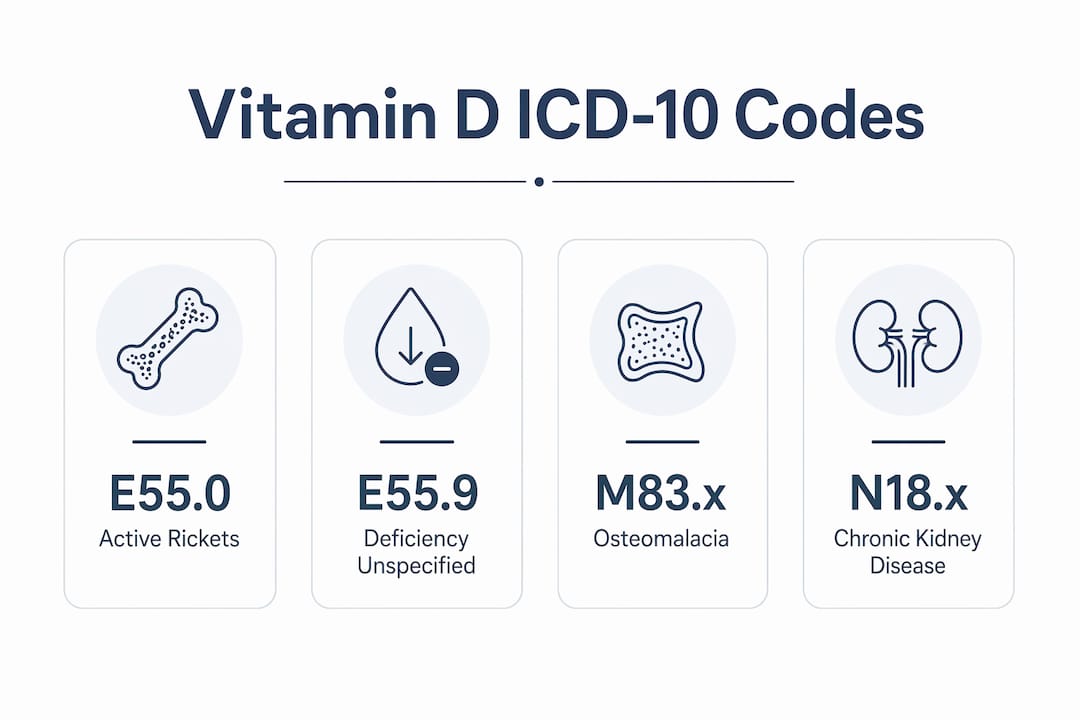
Quick reference: code families that typically support coverage
- E55.0 — Active rickets
- E55.9 — Vitamin D deficiency, unspecified (use only when no more specific code applies)
- M83.x — Adult osteomalacia and related conditions
- Chronic kidney disease codes (N18.x series)
- Malabsorption codes (K90.x series, including celiac disease and post-bariatric states)
- Relevant endocrine disorder codes
Bottom line for patients: Before your appointment, ask your provider to document the specific condition driving the test order and to note which vitamin D metabolite is being tested (25-hydroxyvitamin D or 1,25-dihydroxyvitamin D). That documentation is what Medicare reviewers look for.
Table of Contents
- Which ICD-10 diagnosis codes support medical necessity for vitamin D testing?
- Why Medicare limits routine vitamin D screening
- Documentation and billing tips to secure Medicare reimbursement
- Common clinical scenarios and the ICD-10 codes that support coverage
- What to do when Medicare denies a vitamin D test claim
- Key Takeaways
- The part of vitamin D billing most patients never hear about
- Eivdiagnostics makes vitamin D testing accessible in Tulare
- Useful sources
- FAQ
Which ICD-10 diagnosis codes support medical necessity for vitamin D testing?
CMS billing guidance lists specific ICD-10-CM codes that providers must use to establish medical necessity for vitamin D assays under Medicare. The key principle is to pick the most specific code that describes the patient’s actual condition. Using E55.9 as a catch-all when a more precise code exists is a common billing mistake that invites denials.
Commonly used code families:
- E55.0 — Active rickets (children and adults with bone-softening disease)
- E55.9 — Vitamin D deficiency, unspecified (appropriate only when no specific underlying cause is coded)
- M83.0–M83.9 — Puerperal and adult osteomalacia; use the most specific subcode
- N18.1–N18.6 — Chronic kidney disease stages 1–5 and end-stage renal disease
- K90.0 — Celiac disease (malabsorption)
- K90.3 — Pancreatic steatorrhea and other malabsorption states
- K91.2 — Post-bariatric surgery malabsorption
- E21.x — Hyperparathyroidism (endocrine indication for 1,25-dihydroxy testing)
- M81.x — Osteoporosis without pathological fracture
Providers should also consult the LCD L34658 code list, which maps specific diagnoses to CPT code 82652 (vitamin D assay) and flags which combinations are covered.
Pro Tip: Before your visit, ask your provider: “Can you document the specific diagnosis that makes this vitamin D test medically necessary?” If your chart says only “check vitamin D levels,” that is not enough for Medicare. A note that reads “25-OH vitamin D to evaluate suspected osteomalacia in the context of malabsorption” is far more defensible.

Why Medicare limits routine vitamin D screening
CMS policy is direct: vitamin D testing may not be used for routine screening of Medicare beneficiaries. The restriction exists because evidence does not support universal screening for asymptomatic patients, and routine testing drives up unnecessary costs across the program.
How LCDs and MAC rules work in practice:
- A Local Coverage Determination (LCD) is issued by a Medicare Administrative Contractor (MAC) for a specific jurisdiction. Your claim is reviewed against the LCD that applies to your region.
- If the diagnosis code on the claim does not appear on the LCD’s covered-indications list, the claim is automatically denied at adjudication.
- The Medicare Recovery Audit Program has approved vitamin D assay medical necessity as an active audit topic, which means weak documentation can trigger retrospective reviews and repayment demands.
The 25-OH vs. 1,25-OH distinction matters. The standard test for assessing vitamin D status is 25-hydroxyvitamin D (CPT 82306). The 1,25-dihydroxyvitamin D test (CPT 82652) is reserved for specific renal or endocrine disorders, such as CKD with suspected calcitriol dysregulation or hyperparathyroidism. CMS guidance explicitly states that documentation must justify which metabolite is ordered and why. Billing both tests together as routine is discouraged and will likely trigger a denial.
Documentation and billing tips to secure Medicare reimbursement
Getting the ICD-10 code right is only half the job. The chart note behind the claim is what survives an audit.
- Link the test order to a specific diagnosis. The order must reference the ICD-10 code and the clinical reason, not just “vitamin D level.”
- Record clinical findings. Include relevant lab results, radiology reports (e.g., bone density scan showing osteopenia), or medication history that supports the diagnosis.
- State the metabolite and rationale. Write explicitly: “Ordering 25-OH vitamin D to assess status in the context of celiac disease” or “1,25-OH vitamin D to evaluate suspected renal tubular disorder.”
- Avoid E55.9 as a default. CMS billing articles warn that claims without a valid, specific ICD-10 code will be returned as incomplete. E55.9 is appropriate only when no more specific code applies.
- For follow-up monitoring: Document the baseline level, the date replacement therapy started, and the monitoring plan. Medicare may cover follow-up testing to confirm a patient has reached a therapeutic range of 20–50 ng/mL, but a generic “recheck” order without that context is frequently denied.
- Attach supporting notes when possible. A brief addendum referencing the clinical rationale can accompany a claim on appeal.
Pro Tip: After your appointment, request a copy of the visit note. Check that it names your diagnosis, the specific test ordered, and the clinical reason. If it reads vaguely, ask the provider’s office to add a clarifying addendum before the claim is submitted. Correcting documentation before submission is far easier than appealing after a denial.
Common clinical scenarios and the ICD-10 codes that support coverage
| Clinical Indication | ICD-10 Code Family | Vitamin D Metabolite Typically Ordered |
|---|---|---|
| Osteoporosis / osteopenia | M81.x | 25-hydroxyvitamin D |
| Adult osteomalacia | M83.x | 25-hydroxyvitamin D |
| Chronic kidney disease | N18.x | 1,25-dihydroxyvitamin D |
| Celiac disease / malabsorption | K90.0, K90.3 | 25-hydroxyvitamin D |
| Post-bariatric surgery | K91.2 | 25-hydroxyvitamin D |
| Rickets | E55.0 | 25-hydroxyvitamin D |
| Hyperparathyroidism | E21.x | 1,25-dihydroxyvitamin D |
| Obesity with clinical justification | — | 25-hydroxyvitamin D |
A few notes on this table. CKD is the primary indication for the 1,25-dihydroxy test because the kidney converts 25-OH to the active hormone; measuring the precursor alone misses the conversion defect. For obesity, LCD L33996 recognizes it as a high-risk condition, but providers must document the individual clinical rationale, not just the diagnosis code.
Follow-up monitoring is covered when deficiency is confirmed and replacement therapy is underway. The chart should record the baseline level, the replacement regimen, and the target range commonly recognized for therapeutic success, which Medicare typically defines as 20–50 ng/mL.
What to do when Medicare denies a vitamin D test claim
- Read the denial reason. The Explanation of Benefits (EOB) will state whether the denial was for lack of medical necessity, missing documentation, or an invalid code.
- Contact your provider’s billing office. Ask whether the ICD-10 code submitted matches your documented diagnosis and whether supporting clinical notes were attached.
- Request a corrected claim. If the wrong code was used or documentation was missing, the provider can submit a corrected claim before filing a formal appeal.
- File a redetermination (Level 1 appeal). Submit to your MAC within 120 days of the denial. Include the visit note, lab orders, and any supporting radiology or lab results.
- Escalate if needed. If the redetermination is denied, you can request a Qualified Independent Contractor (QIC) review, then an Administrative Law Judge (ALJ) hearing.
- Consider self-pay as a parallel option. If the appeal timeline is long and you need results now, a direct-to-consumer test through a lab like Eivdiagnostics lets you get tested without waiting for the insurance process to resolve.
Pro Tip: Because vitamin D testing is an active RAC audit topic, the documentation details that win appeals are specific: the date replacement therapy started, a baseline lab value, and a radiology or lab report that supports the diagnosis. Collect those items before you file.
Key Takeaways
Medicare covers vitamin D testing only when a specific ICD-10 diagnosis code documents medical necessity; routine screening is excluded under CMS policy and Local Coverage Determinations.
| Point | Details |
|---|---|
| Routine screening is not covered | Medicare requires a documented medical diagnosis tied to the test order, per CMS LCD policy. |
| Use the most specific ICD-10 code | E55.x, M83.x, N18.x, and K90.x are common families; avoid defaulting to E55.9 when a more precise code applies. |
| Metabolite choice affects coverage | 25-hydroxyvitamin D is standard; 1,25-dihydroxyvitamin D is reserved for renal or endocrine indications. |
| Follow-up testing requires documentation | Chart notes must record baseline level, replacement start date, and monitoring plan; therapeutic target is 20–50 ng/mL. |
| Eivdiagnostics offers a direct-pay path | Patients in Tulare who face denials or want convenient testing can use Eivdiagnostics’s mobile phlebotomy and self-pay options. |
The part of vitamin D billing most patients never hear about
Most articles about Medicare and vitamin D testing focus on whether you will get covered. The more useful question is why so many claims fail even when the clinical need is real.
The answer is almost always documentation, not diagnosis. A patient with confirmed osteomalacia and a legitimate need for a 25-OH vitamin D test can still get denied if the order reads “check vitamin D” with no ICD-10 code attached, no reference to the underlying condition, and no note explaining why this specific metabolite was chosen. The claim looks identical to a routine screening request, and Medicare’s adjudication system treats it that way.
What patients and caregivers can do is ask one direct question at every relevant visit: “Does my chart note connect this test to my specific diagnosis?” That single question, asked before the claim is submitted, prevents most of the denials I see discussed in billing forums and appeals guidance. The system is not designed to be adversarial. It is designed to require specificity, and specificity is something you can ask for.
Eivdiagnostics makes vitamin D testing accessible in Tulare
When Medicare denies a vitamin D test or the documentation process feels like a barrier, the practical alternative is a lab that works directly with you. Eivdiagnostics, an independent pathology laboratory serving Tulare and the surrounding Central Valley, offers clinical pathology services including vitamin D assays with no insurance requirement.
If you have a prescription, Eivdiagnostics can process your test through insurance where applicable. If you prefer to self-pay or your Medicare claim was denied, direct-to-consumer pricing is available with no referral needed. The lab’s mobile phlebotomy service brings the blood draw to your home or office, which is particularly useful for patients managing mobility issues or chronic conditions that already require frequent appointments. All testing is overseen by board-certified pathologists, and results are reported with the specificity providers need for accurate documentation. Eivdiagnostics cannot change Medicare’s coverage rules, but it can make sure your test is ordered, collected, and reported in a way that supports your provider’s documentation. To get started, visit the lab test packages page or contact Eivdiagnostics directly to discuss your testing needs.
Coverage follows CMS and LCD rules; Eivdiagnostics cannot guarantee Medicare reimbursement for any specific test.
Useful sources
- LCD L37535 — Vitamin D Assay Testing: Primary CMS LCD covering medical necessity criteria and follow-up monitoring rules.
- LCD L33996 — Vitamin D Assay Testing: MAC-specific LCD addressing routine screening exclusions and high-risk conditions.
- LCD L34658 — Vitamin D Assay Testing: Includes ICD-10 code charts mapped to CPT 82652 for claim verification.
- Billing and Coding Article 57736: CMS billing guidance on code selection, metabolite documentation, and claim completeness.
- Medicare RAC Approved Topic — Vitamin D Assay Testing: Confirms vitamin D testing is an active audit topic; relevant for appeals preparation.
To verify which LCD applies to your region, use the CMS Medicare Coverage Database and search by your MAC jurisdiction. You can also call 1-800-MEDICARE or contact your MAC directly to ask which LCD governs vitamin D assay claims in your area. Keep copies of all visit notes, lab orders, and test results whenever you submit or appeal a claim.
This article is general information, not medical or legal advice. Confirm current coverage rules with CMS, your MAC, or a qualified billing professional for your specific situation.
FAQ
Does Medicare cover routine vitamin D screening?
No. CMS policy explicitly excludes routine vitamin D screening; coverage applies only when testing is medically necessary and tied to a documented diagnosis.
What ICD-10 codes are used for Medicare vitamin D testing?
Common codes include E55.0 (active rickets), E55.9 (vitamin D deficiency, unspecified), M83.x (osteomalacia), N18.x (chronic kidney disease), and K90.x (malabsorption). Providers must select the most specific code for the patient’s condition.
What is the difference between 25-OH and 1,25-OH vitamin D tests for Medicare?
25-hydroxyvitamin D is the standard status test for most indications; 1,25-dihydroxyvitamin D is reserved for specific renal or endocrine disorders. Medicare requires documentation justifying which metabolite was ordered and why.
What should I do if Medicare denies my vitamin D test claim?
Ask your provider’s billing office to review the ICD-10 code and attached documentation, then request a corrected claim or file a Level 1 redetermination appeal with your MAC within 120 days of the denial.
Can I get a vitamin D test without going through Medicare?
Yes. Eivdiagnostics offers direct-to-consumer vitamin D testing with no insurance requirement, including mobile phlebotomy for patients in Tulare who prefer an in-home blood draw.
Recommended
- CMP Test Code 10231: What It Measures and Why It Matters | EIV Diagnostics | EIV Diagnostics
- Top 4 Affordable Lab Testing Providers 2026 | EIV Diagnostics | EIV Diagnostics
- EIV Diagnostics | Independent Pathology Laboratory | EIV Diagnostics
- EIV Diagnostics | Independent Pathology Laboratory | EIV Diagnostics