
July 15, 2026
How to Get Blood Work Done Without a Doctor
Learn how to get blood work done without a doctor. Order online, visit a lab, and get results in 1–3 days. Discover your options now!

Direct-to-consumer (DTC) lab testing is defined as the ability to order clinical blood tests online without a doctor’s referral, insurance approval, or physician visit. If you want to know how to get blood work done without a doctor, the answer is straightforward: you browse tests online, pay directly, visit a certified collection site, and receive results in 1–3 business days. Individuals can order blood work in 47–48 U.S. states without a doctor’s order. That access has made DTC testing one of the fastest-growing segments in consumer health. Kings County residents have real options here, and this guide walks you through every step.
How to get blood work done without a doctor: what you need to know first
DTC lab testing uses CLIA-certified labs that meet the same federal quality standards doctors use. Quest Diagnostics and Labcorp are the two largest national networks, with thousands of collection sites across the country. That means the blood panel you order yourself carries the same clinical accuracy as one your physician orders. The difference is who initiates the request.

When you place an order online, a licensed clinician reviews and authorizes the requisition before it reaches the lab. This physician-in-the-loop model keeps the process legally compliant without requiring you to book a doctor’s appointment. You never interact with that clinician directly. The review happens in the background, typically within minutes.
This model works because DTC platforms partner with licensed physicians who sign off on orders electronically. The result: you get clinical-grade testing without the traditional gatekeeping. For people without a family doctor, without insurance, or simply without time, that distinction matters enormously.
What legal considerations and state restrictions should you know?
Most of the country allows self-ordered blood tests, but three states do not. New York, New Jersey, and Rhode Island require a physician’s signature on every lab requisition. These states maintain strict “corporate practice of medicine” laws that prevent labs from selling tests directly to patients. If you live in one of these states, you have two practical options.
Option 1: Telehealth standing orders. Some DTC platforms operate telehealth services that connect you with a licensed physician in a permissive state. Telehealth standing orders serve as a legal workaround, allowing physicians to authorize requisitions asynchronously without an in-person visit. The physician reviews your request electronically and signs off, satisfying the legal requirement.
Option 2: Cross-state testing. Laws apply where the blood draw physically occurs, not where you live. Residents in restricted states can legally obtain lab work by traveling to a neighboring state without direct ordering restrictions. For a New Jersey resident, a short drive into Pennsylvania solves the problem entirely.
Kings County falls under California law, which permits DTC lab testing. California residents face no state-level barrier to ordering blood work without a doctor’s order. You can check state-level access differences before placing your first order to confirm your specific situation.
Pro Tip: If you are unsure whether your county or state has additional restrictions, call the collection site directly before purchasing a test online. It takes two minutes and prevents a wasted trip.
How to prepare and order blood work without a doctor
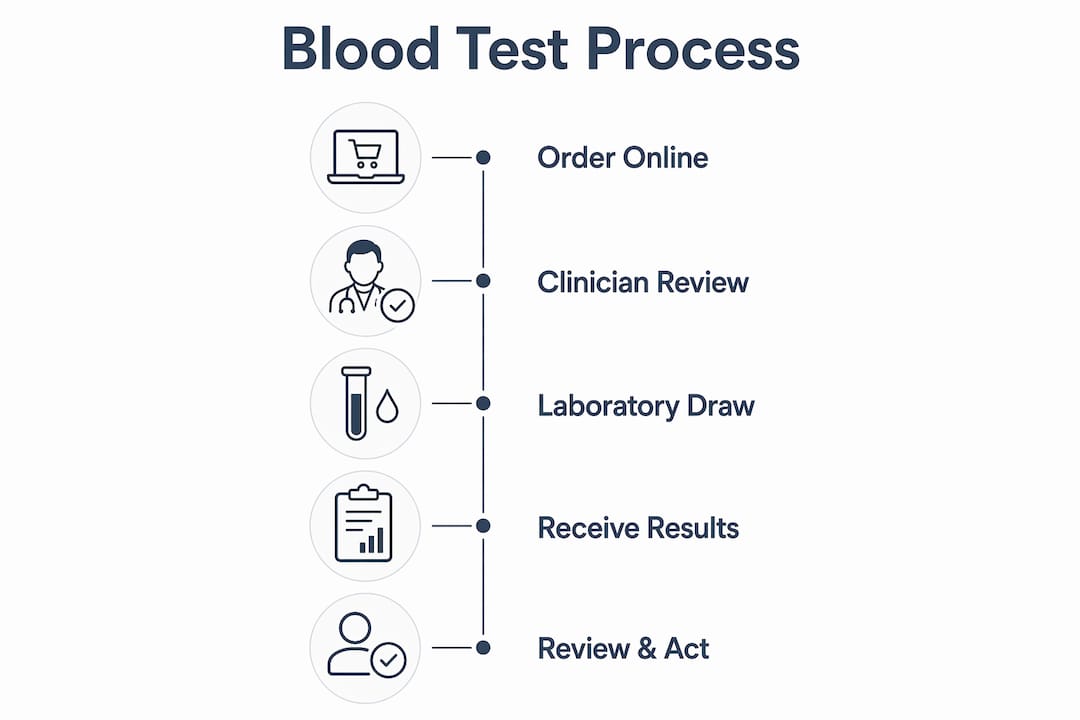
Ordering a blood test without a doctor follows a clear sequence. Each step is straightforward, and the entire process from order to results typically takes under a week.
-
Choose your tests. Browse by health category: metabolic health, thyroid function, hormone levels, vitamin deficiencies, or cardiovascular risk. Most DTC platforms list prices upfront with no hidden fees. A basic metabolic panel typically costs far less than an urgent care visit.
-
Place your order online. Pay directly on the platform. No insurance form, no referral code, no prior authorization. After payment, you receive a requisition form by email, usually within minutes.
-
Find a collection site. Enter your zip code to locate a nearby certified lab. Kings County has multiple collection sites within driving distance. You can also check whether mobile phlebotomy is available in your area, which brings the blood draw to your home or office.
-
Follow preparation instructions. Some tests, particularly fasting glucose and lipid panels, require 8–12 hours without food before your draw. Read the instructions on your requisition form carefully. Skipping this step can invalidate your results.
-
Visit the collection site. Bring your requisition form and a photo ID. The phlebotomist will collect your sample and send it to the lab.
-
Receive your results. Results arrive in a secure online portal within 1–3 business days. You get a notification by email or text when they are ready.
Pro Tip: Scheduling an appointment reduces wait time significantly, especially during morning hours when fasting test volume peaks. Walk-ins are accepted, but a booked slot gets you in and out faster.
What to expect when visiting a lab for your blood draw
The lab visit itself is the simplest part of the process. A certified phlebotomist handles your sample collection, and the blood draw takes 5–15 minutes from check-in to exit. No insurance card is needed at the desk. You present your requisition form and ID, take a seat, and the draw is done before most people finish their morning coffee.
Here is what the visit typically covers:
- Check-in: Present your printed or digital requisition form and photo ID.
- Sample collection: A certified phlebotomist draws blood from a vein, usually in your arm. The process is quick and uses standard sterile technique.
- Labeling and shipping: Your sample is labeled, sealed, and sent to the CLIA-certified processing lab the same day.
- Results notification: You receive an alert when results post to your secure portal, typically within 1–3 business days.
| Step | What happens | Time required |
|---|---|---|
| Check-in | Present requisition and ID | 2–5 minutes |
| Blood draw | Phlebotomist collects sample | 5–10 minutes |
| Lab processing | CLIA-certified lab analyzes sample | 1–3 business days |
| Results delivery | Secure portal notification sent | Immediate on posting |
Cash pay blood tests at certified collection sites carry no surprise billing. The price you paid online is the total cost. That transparency is one of the clearest advantages of self-pay blood work over insurance-billed testing, where out-of-pocket costs can be unpredictable.
How do you understand your blood test results without a doctor?
Results from DTC labs come with reference ranges printed next to each value. Results include reference ranges and basic explanations but lack the clinical context a physician provides. Color-coded charts and educational notes help you identify which values fall outside normal ranges, but they do not tell you what caused the deviation or what to do next.
Here is how to handle your results responsibly:
- Read the reference range first. A value flagged in red or outside the listed range warrants attention. A single out-of-range result is not a diagnosis.
- Note patterns, not single numbers. A slightly elevated cholesterol reading means something different if your triglycerides are also high versus if every other marker is normal.
- Share results with a physician when flagged. DTC lab tests empower patients but do not replace comprehensive medical consultations. If multiple values are flagged, book a telehealth appointment to review them with a licensed clinician.
- Use telehealth for interpretation. Many DTC platforms offer add-on physician consultations. This is the most efficient path from results to clinical guidance without a traditional office visit.
Pro Tip: Download your results as a PDF and bring them to any future medical appointment. Physicians can act on your data faster when you arrive with documented lab history rather than verbal summaries.
You can also review what fast testing results look like in practice before your first order, so you know exactly what format to expect when your portal notification arrives.
Key Takeaways
Direct-to-consumer lab testing gives you legal, clinical-grade access to blood work without a doctor’s visit in 47–48 U.S. states, with results delivered in 1–3 business days through CLIA-certified labs.
| Point | Details |
|---|---|
| DTC testing is legal in most states | 47–48 states allow self-ordered blood work; New York, New Jersey, and Rhode Island restrict it. |
| Licensed clinicians authorize every order | A physician reviews your requisition electronically, keeping the process legally compliant. |
| The blood draw takes under 15 minutes | Certified phlebotomists collect samples quickly; results post to a secure portal within 1–3 days. |
| Results need clinical context for flagged values | Reference ranges guide you, but a telehealth consult is the right next step for out-of-range results. |
| Cash pay eliminates billing surprises | Self-pay blood work shows the full price upfront, with no insurance forms or surprise charges. |
Why self-ordered testing is more than a convenience trend
The first time I walked a patient through ordering their own thyroid panel, they were stunned it was legal. That reaction is common, and it points to a real gap in public awareness. Most people assume blood work requires a doctor’s visit because that is how it has always worked. The system trained us to think that way.
What changed is the regulatory recognition that patients can handle their own health data. The physician-in-the-loop model is not a loophole. It is a thoughtful compliance structure that preserves clinical oversight while removing the friction of scheduling, referrals, and insurance pre-authorization. That friction was never about safety. It was about workflow.
The caution I would add is this: a normal result does not mean you are healthy, and an abnormal result does not mean you are sick. Lab values exist on a spectrum, and context matters. A TSH of 4.5 reads differently in a 25-year-old athlete than in a 55-year-old with fatigue and weight gain. Self-ordered testing is most powerful when you use it as a starting point, not a final answer.
For Kings County residents without a regular physician, DTC testing fills a real gap. It gives you data to bring to a telehealth visit, an urgent care appointment, or a specialist referral. That data makes every subsequent conversation more productive. The goal is not to replace clinical care. It is to show up to clinical care better informed.
— Krunal
Eivdiagnostics makes self-pay lab testing accessible in Kings County
Getting blood work done without a doctor’s visit should not require a complicated process. Eivdiagnostics offers self-pay testing options for patients who want direct access to clinical-grade lab results without insurance or a physician referral.
For patients who prefer not to travel to a collection site, Eivdiagnostics provides mobile phlebotomy services that bring the blood draw to your home or office. Board-certified pathologists process every sample, and results are delivered through a secure portal with fast turnaround times. Whether you need a single panel or a broader lab test package, Eivdiagnostics supports patients at every step, from ordering to results.
FAQ
Can I get blood tests without a doctor in California?
Yes. California permits direct-to-consumer lab testing, so Kings County residents can order blood work online without a doctor’s referral or insurance.
How long does it take to get blood test results without a doctor?
Results from DTC labs typically arrive within 1–3 business days through a secure online portal after your blood draw.
Do I need insurance for self-pay blood work?
No. Cash pay blood tests require no insurance. You pay a fixed price upfront, and there are no additional billing charges after the draw.
What happens if my blood test results are flagged as abnormal?
Flagged results include reference ranges and basic explanations, but a telehealth consultation with a licensed physician is the recommended next step for out-of-range values.
Is the blood work quality the same without a doctor’s order?
Yes. DTC labs use CLIA-certified facilities, the same standard required for physician-ordered tests, so the analytical accuracy is identical.